 Skip to content

THC Gummies in the UK
THC gummies are strictly regulated throughout the United Kingdom. Under the Misuse of Drugs Act 1971, cannabis is classed as a Class B drug. Therefore, THC is classed as a controlled cannabinoid. It is illegal to possess, supply, produce or import THC gummies for recreational use. In November 2018, the government passed legislation to allow for specialist doctors, who are on the General Medical Council Specialist Register, to prescribe cannabis-based products for medicinal use. Psychoactive THC gummies sold online or from traditional high-street stores do not meet legal exemption tests. Legal exemption tests limit any controlled cannabinoids to no more than 1 mg per container and require the product not be designed for human administration.
Most patients will turn to a private specialist clinic to obtain THC gummies legally. Prescriptions from the NHS are very rare. When they occur, they are usually limited to legal medicines for specific conditions such as certain types of epilepsy, multiple sclerosis and spasticity, chemotherapy related nausea, etc. Private clinics have a wider range of options, including some unlicensed cannabis based products, such as oral pastilles that look and function similar to gummies. These are prescribed and regulated to have consistent dosing. Effects take longer to be felt compared to smoking or vaping because of how long it takes for the body to process and break down the edibles. Someone considering this option has to try and be assessed for other more conventional and available treatment options first.
Buying or obtaining THC gummies through non-approved sources puts a consumer at risk for un-regulated and unknown doses, contamination and possible criminal liability. It is an offense to drive while impaired by THC. Prescriptions do not exempt people from this. THC gummies are popular right now, but articles like this are for legal and educational purposes only. This article does not give legal or medical advice. Always consult qualified and licensed medical professionals to get up to date information.
New Arrivals
- THC GUMMIES UK
THC Gummies UK – Willo 1000mg Marijuana Gummies – Guava Sorbet
30 £Rated 4.69 out of 5


UK Legal & Regulatory Framework (FSA & Home Office Compliance)
The UK maintains a strict dual framework for THC gummies and related products. The Home Office enforces the Misuse of Drugs Act 1971, which classifies cannabis as a Class B drug and controls THC as a cannabinol derivative. Possession, supply or production of THC gummies outside authorised channels remains unlawful. An exempt-product rule under the Misuse of Drugs Regulations 2001 allows only products that meet three tests: they are not designed for human administration, the controlled substance cannot be readily recovered, and no component part contains more than 1 mg of any controlled cannabinoid. The Food Standards Agency treats CBD extracts as novel foods that require formal authorisation before legal sale.
Compliance demands careful separation of THC and CBD rules. Pure isolated CBD itself is not controlled, yet finished products such as gummies must satisfy both Home Office limits and FSA novel-food requirements. As of September 2026 the FSA board recommends the first three high-purity CBD applications for ministerial approval, each capped at 10 mg daily intake for adults and subject to strict residual THC specifications. THC gummies that deliver a psychoactive dose fall outside these exemptions and remain available only via specialist prescription as cannabis-based products for medicinal use. Retail claims that ignore these thresholds create real legal and consumer risk.
Building trust starts with clear, accurate information rather than marketing slogans. Responsible operators test every batch to ISO standards, publish certificates of analysis, and refuse to sell products that exceed the 1 mg controlled-cannabinoid limit per container. Consumers benefit when sites explain the difference between prescribed medical THC gummies and unregulated alternatives. This article serves legal and educational purposes only. It does not constitute advice. Always consult official Home Office and Food Standards Agency guidance, and seek professional medical or legal counsel before acting. Accurate compliance protects both public safety and long-term market integrity.
Are THC Gummies Legal in the UK? Current Laws & Misconceptions
People often ask us whether THC gummies are legal in the UK. Currently the answer is no, although this is being reviewed on an ongoing basis. For the time being, they remain classified under the Misuse of Drugs Act 1971 as a Class B controlled drug. THC is also controlled under this Act. Therefore, gummies that produce a noticeable effect are technically illegal. The only legal route for higher strength gummies is a prescription for a medicinal cannabis-based product. Please note that the so-called ‘1 mg rule’ does not allow for the sale of recreational THC edibles.
The ‘1 mg rule’ is part of the exempt-product definition in Regulation 2 of the Misuse of Drugs Regulations 2001. For a product to qualify for this definition it must meet all three criteria. It must not be designed for the administration of a controlled drug to a human or animal. The controlled drug must not be recoverable by readily applicable means. No single component part may contain more than 1 mg of any controlled cannabinoid. The Home Office treats the container itself as a component part. Therefore a pack of gummies is a component part, and the total can not exceed that. High THC recreational edibles fail these tests and remain illegal to possess, supply or import without authority.
Misconceptions spread quickly online. Labels that simply say “hemp” or “low THC” do not create an exemption. Products sold as sweets or as a supplement that contain psychoactive THC are illegal. Prescribed, medical oral forms e.g. pastilles, are exempt, and require special clinical oversight and sponsorship. This article is for legal and educational purposes only. This is not legal or medical advice. For legal or medical advice, you should always consult the latest Home Office factsheet and/or seek legal or medical advice before purchasing or using any cannabinoid products. Understanding the law protects the consumer and upholds compliance.
FSA Novel Foods Approval & CBD Gummy Compliance
The UK Food Standards Agency (FSA) regulates cannabidiol (CBD) edibles under the novel foods framework. This includes CBD sweets, gummies and other hemp-derived foods. Businesses selling THC gummies must understand that CBD approval does not automatically make THC-containing edibles legal. CBD foods require novel food authorisation before sale, subject to the applicable rules in each UK nation. The FSA Public List identifies products linked to progressing authorisation applications. However, inclusion does not equal full approval. Retailers should verify product status, supplier details and labelling before stocking CBD gummies or making compliance claims. [1]
The FSA assesses CBD safety using toxicological evidence, manufacturing controls and cannabinoid testing. Its provisional acceptable daily intake is 10 mg of CBD per day for a healthy adult weighing 70 kg, equivalent to 0.15 mg per kilogram of body weight. This is a safety benchmark, not a recommended serving or a guarantee of zero risk. Proposed authorisations also address product purity, trace THC levels and labelling. Consumers should understand that THC is a psychoactive, controlled substance under UK drug law. THC gummies are not automatically lawful because they contain hemp-derived ingredients or appear on a CBD-related list. [1][2]
In 2026 and 2027, businesses must monitor authorisation decisions, updated FSA guidance and any changes affecting market access. In August 2026, the FSA updates its CBD guidance, while its consultation on three CBD novel food applications outlines proposed authorisation conditions. Final decisions rest with the relevant ministers; proposals alone do not constitute approval. Food businesses should check the current Public List, retain certificates of analysis, verify cannabinoid levels and update labels when required. The rules differ across England, Wales, Scotland and Northern Ireland. Disclaimer: This article provides general legal and educational information, not legal or medical advice. Always consult official guidance before selling or consuming THC gummies
The Legality of Importing THC Gummies into the UK (Customs & Border Force)
Importing THC gummies into the UK carries significant legal risks, even when overseas retailers sell them legally. Products purchased from US dispensaries or shops in the Netherlands and Thailand remain subject to UK law when they enter the country. The Misuse of Drugs Act 1971 generally prohibits importing controlled drugs without the required legal authority. THC, the intoxicating compound in cannabis, falls under UK controlled drug legislation, subject to specific exceptions. A foreign prescription, dispensary receipt or legal purchase does not automatically authorise importation. Travellers and online shoppers should check official guidance before ordering cannabis edibles.
Border Force can intercept THC gummies in luggage, postal deliveries and commercial shipments. Suspected products may be detained, examined and seized. Officers may refer a suspected controlled substance for testing or further investigation. Seizure does not automatically mean a person faces prosecution, but it can trigger further enquiries. HMRC and Border Force provide formal procedures for challenging certain seizures. Notices explain the relevant process and deadlines. Buyers should not assume that discreet packaging, a small quantity or a personal-use claim prevents enforcement. Official customs guidance confirms that controlled drugs are prohibited goods unless a lawful exception applies. [2][3]
Section 3 of the Misuse of Drugs Act 1971 prohibits importing controlled drugs unless an applicable exception or licence permits it. Section 5 also addresses unlawful possession. Importing THC gummies may therefore expose a person to seizure, investigation and potential criminal proceedings. Penalties depend on the offence and circumstances. Prescribed cannabis-based medicines follow separate rules and do not make ordinary recreational gummies lawful imports. Before travelling or ordering overseas products, consult Home Office guidance and obtain specialist legal advice where necessary. Disclaimer: This article is for general educational purposes only. It is not legal advice. Laws and individual circumstances vary, so verify current official requirements before acting
Hemp Seed Oil Gummies vs. THC/CBD Gummies: UK Consumer Guide
Hemp seed oil gummies and THC gummies are not the same product. Hemp seed oil comes from hemp seeds and provides dietary fats, including omega-3 and omega-6 fatty acids. It does not naturally contain significant amounts of CBD or THC. Food-grade hemp seed oil is available through supermarkets, high-street retailers and online marketplaces. By contrast, CBD gummies contain cannabidiol, while THC gummies contain tetrahydrocannabinol, a psychoactive cannabinoid. These ingredients have different effects and legal status. Always read the ingredient list carefully. A hemp label alone does not prove that a product contains cannabinoids.
Some product listings use terms such as “hemp extract”, “full spectrum” or “cannabis gummies” without clearly explaining the ingredients. Consumers should check the declared cannabinoid content, dosage, manufacturer and independent laboratory reports where available. Hemp seed oil gummies may be ordinary food supplements, but adding CBD can change a product’s regulatory status. In the UK, CBD foods are generally classed as novel foods and require authorisation before lawful sale. The FSA Public List identifies certain products linked to progressing applications. Listing does not mean full authorisation or FSA endorsement. Treat unsupported health claims with caution.
The Food Standards Agency distinguishes traditional hemp seed foods from CBD extracts and other novel hemp-derived ingredients. In England and Wales, businesses must follow applicable novel food requirements and check current FSA guidance. Scotland has separate food safety oversight through Food Standards Scotland, while Northern Ireland has its own applicable arrangements. THC raises additional concerns because it is a controlled substance under UK law, subject to limited legal exceptions. Do not assume that a product is lawful because it is sold online or labelled “hemp-derived”. Disclaimer: This guide is for educational purposes only and does not constitute legal, medical or purchasing advice.
What Our Customers Say


NHS & Private Prescription Pathways (Medicinal Access)
Potential THC gummy patients in the UK need legal information about accessing medical cannabis. There are pathways for the prescription of cannabis-based products by the NHS and privately. THC gummies sold recreationally are not prescription drugs. In the NHS, the consideration for the prescription of medicinal cannabis is restricted to a few severe conditions (e.g. chemotherapy-related nausea and vomiting, epilepsy and symptoms related to multiple sclerosis). The conditions for eligibility are evaluated based on clinical evidence and available guidance. It is good practice for a patient to discuss their symptoms and the treatments they have tried with their healthcare team before considering medicinal cannabis.
The NHS prescription of cannabis remains very restricted. A doctor in a hospital specializes in assessing the need for the prescription, based on the patient’s existing conditions, clinical evidence and symptoms, and the suitability of other available treatment options. Private clinics have doctors that are qualified to assess the need for the prescription of medicinal cannabis. Payment at a private clinic, however, does not guarantee that a prescription will be issued. Most of the prescriptions for cannabis in the UK, based on regulations, will be issued by doctors on the Specialist Register of the General Medical Council. A patient should research the clinics to verify their credentials and the process for prescriptions before booking a consultation. It is the responsibility of the patient to provide their relevant medical history and supporting evidence.
When patients seek out THC gummies or medicinal cannabis pastilles, they should be aware that the prescribed product is decided based on the clinical need and the legal availability of the product. THC gummies may not be prescribed if the legal framework of your country doesn’t allow it. THC gummies or pastilles are just one of the several other available forms of medicinal cannabis (i.e. oils, capsules, and sprays).
THC gummies may not be available even if a clinic prescribes cannabis-based treatment. There may be other available forms of medicinal cannabis. You should enquire which form is appropriate for you. You also have to consider whether it can be legally supplied by a registered pharmacy. Unverified sources may pose a bigger risk to public health by offering products marketed as prescription alternatives. This article does not provide medical or legal advice. It is in the best interest of the public health to educate the readers on the general info related to the topic before they make any further treatment decisions after seeking advice from a licensed professional.
How to Get a Prescription for Medical THC Gummies in the UK
Patients seeking THC gummies by prescription in the UK first need to understand the difference between recreational edibles and cannabis-based medicinal products (CBMPs). Legal medicinal cannabis is available only through authorised prescribing pathways. For most unlicensed CBMPs, the initial prescription must come from a doctor on the General Medical Council’s (GMC) Specialist Register. NHS access remains limited, while private clinics offer specialist assessments for suitable patients. Products may include oils, capsules or pastilles, depending on clinical need and availability. A prescription does not guarantee access to a specific gummy formulation.
Start by gathering your diagnosis, medical history and records of previous treatments. Next, discuss suitable options with your GP or treating specialist. For private care, review established services such as Curaleaf Clinic, Alternaleaf or Releaf. Check each clinic’s eligibility criteria, fees and follow-up arrangements. Some clinics require evidence of a diagnosis and previous conventional treatments. A specialist then reviews your records and assesses whether medicinal cannabis is clinically appropriate. The assessment may take place remotely or in person, depending on the provider’s process and clinical needs.
If treatment is appropriate, the specialist selects the medicine, formulation and dose. Some UK providers list medicinal cannabis pastilles, but availability depends on the prescriber and dispensing pharmacy. Patients cannot choose or purchase prescription THC gummies independently as a substitute. Follow-up appointments monitor benefits, side effects and ongoing suitability. Check provider registration and confirm who manages your care before paying fees. THC medicines can cause dizziness, sedation and other adverse effects, and may interact with existing medicines. Disclaimer: This guide is educational, not medical or legal advice.
NHS vs. Private Cannabis Clinics: Why NHS THC Gummies Are Rare
The NHS rarely prescribes THC gummies because medicinal cannabis requires careful clinical assessment, and evidence for many cannabis-based medicinal products remains limited. NICE guideline NG144 recommends specific treatments for defined conditions rather than routine cannabis prescribing. These include THC mouth spray for eligible adults with multiple sclerosis-related spasticity and certain cannabidiol treatments for severe epilepsy. Other options apply to chemotherapy-related nausea. THC gummies are not a standard NHS treatment. Most unlicensed cannabis medicines are not first-line options. Specialists consider established treatments, clinical evidence, safety risks and individual needs before recommending a cannabis-based medicinal product
Private cannabis clinics provide specialist assessments for patients who seek treatment outside routine NHS pathways. GMC Specialist Register doctors may prescribe unlicensed cannabis-based medicinal products when they judge treatment clinically appropriate. However, private access does not mean automatic approval. Clinicians review diagnoses, previous treatments, medical history, potential interactions and risks. THC can cause sedation and may carry dependence risks. Private treatment also involves consultation, prescription and dispensing costs. NHS England states that unlicensed cannabis medicines are not routinely commissioned by the NHS. Private clinics operate under the same core prescribing law, although patients pay for consultations and treatment themselves.
Patients searching for NHS THC gummies should know that a prescription does not guarantee access to a particular edible. UK medicinal cannabis is supplied in suitable prescribed formulations, which may include oils, capsules or other products. A specialist and dispensing pharmacy confirm what is lawful and available. NICE guidance prioritises evidence-based care and careful monitoring. For many conditions, the evidence does not support routine use of THC-containing products. Patients should discuss treatment options with their NHS specialist or a qualified private prescriber. Disclaimer: This article is for educational purposes only and does not replace medical or legal advice.
Medical Cannabis Eligibility in the UK: Qualifying Conditions
Medical cannabis eligibility in the UK depends on your diagnosis, treatment history and a specialist’s clinical assessment. Private clinics assess conditions such as chronic pain, anxiety, multiple sclerosis (MS), epilepsy and post-traumatic stress disorder (PTSD). However, eligibility does not guarantee a prescription for THC gummies. UK specialists consider whether cannabis-based medicinal products (CBMPs) offer potential benefits when standard treatments prove ineffective, unsuitable or poorly tolerated. Most unlicensed products are not first-line treatments. The NHS follows narrower guidance, particularly for chronic pain. A specialist decides whether treatment is appropriate after reviewing your medical records and individual risks.
Private medical cannabis clinics may assess chronic pain, anxiety and PTSD when conventional care provides insufficient relief. Some also assess MS symptoms and epilepsy, although treatment depends on the specific diagnosis and evidence. For MS, THC mouth spray may be considered for moderate to severe spasticity after other medicines fail. Certain CBD medicines have specific roles in severe epilepsy. Chronic pain and anxiety require careful assessment because evidence and prescribing decisions vary. NICE does not recommend THC for routine adult chronic pain treatment. A THC gummies prescription is never automatic, and a clinician may recommend another formulation instead.
The “two prior treatments” requirement commonly appears in private clinic eligibility assessments. Patients usually need evidence that at least two appropriate conventional treatments have failed, caused unacceptable side effects or proved unsuitable. This is not a universal legal rule that guarantees eligibility. Specialists must consider the relevant clinical guidance, diagnosis, previous medicines, treatment duration and individual risks. Prepare your Summary Care Record, medication history and details of previous therapies. Include the outcomes and any side effects. A GMC Specialist Register doctor with relevant expertise must initiate most unlicensed CBMP prescriptions. The final decision remains clinical, not simply administrative.
Understanding Medicinal Pastilles and Sublingual Wafers in UK Pharmacies
Medicinal pastilles and sublingual wafers are specialised dosage forms designed for convenient medicine delivery. Pastilles usually dissolve slowly in the mouth, while sublingual wafers dissolve beneath the tongue. Their suitability depends on the active ingredient, formulation and clinical purpose. People researching THC gummies in the UK should understand that familiar edible formats are not automatically recognised medicines. Cannabis-based products for medicinal use (CBPMs) require lawful prescribing and supply. Most unlicensed products need a specialist prescription. A pharmacist can explain the prescribed product, administration method and storage requirements. Never assume every soft chew is a pharmaceutical preparation.
Pharmaceutical quality depends on controlled manufacturing, suitable ingredients, documented testing and traceable supply. Good Manufacturing Practice (GMP) sets standards for consistent medicine quality and safe production. Good Distribution Practice supports proper storage and transport. In Australia, TGO standards apply within their relevant regulatory scope; they are not a substitute for UK requirements. UK patients should ask whether a product is licensed or supplied as an unlicensed medicine under applicable rules. Gelatin-based pastilles, soft chews and THC gummies are not interchangeable terms. A dosage form must be specifically manufactured, assessed and prescribed for its intended medical use.
UK specialist pharmacies dispense cannabis-based medicines against valid prescriptions and within applicable legal requirements. However, patients should not assume that THC gummies, gelatin pastilles or sublingual wafers are routinely available. The prescribed formulation depends on clinical need, product quality and lawful supply. Ask the specialist and dispensing pharmacist about ingredients, THC strength, dosing instructions, interactions and possible side effects. Avoid unregulated online products, which may have uncertain contents or potency. This article is for educational purposes only and does not provide medical or legal advice. Consult a qualified clinician or pharmacist before making decisions about medicinal cannabis or changing treatment.
Clinical Pharmacology & Pharmacokinetics
Understanding the clinical pharmacology of THC gummies helps explain how the body absorbs, processes and eliminates cannabinoids. Pharmacokinetics describes what the body does to a substance over time. After someone swallows a THC-containing product, digestion releases its active compounds into the gastrointestinal tract. THC passes through the intestinal wall and enters the portal circulation before reaching the liver. This first-pass process reduces the amount of unchanged THC entering the bloodstream. Absorption varies between products and individuals. Food composition, formulation, metabolism and other medicines can all influence cannabinoid exposure. These differences make oral THC effects difficult to predict
The liver converts THC into several metabolites, including 11-hydroxy-THC, which remains psychoactive and contributes to oral cannabis effects. THC also interacts with cannabinoid receptors, particularly CB1 receptors in the central nervous system. These interactions influence perception, memory, coordination and mood. Oral THC often takes longer to produce noticeable effects than inhaled cannabis. Peak blood concentrations may occur around two hours after ingestion, although timing varies considerably. Effects can persist for several hours. Repeated doses taken too soon can increase unwanted intoxication. This delayed response makes professional guidance and careful monitoring important.
After metabolism, the body eliminates THC breakdown products mainly through faeces and, to a lesser extent, urine. THC also distributes into fatty tissues, which affects its persistence in the body. Medicines, liver function, food intake and individual biology can alter cannabinoid exposure. THC and CBD may interact with prescribed medicines, so patients should disclose all treatments to their clinician or pharmacist. Possible adverse effects include dizziness, drowsiness, anxiety and impaired concentration. In the UK, prescribed cannabis-based medicines require appropriate clinical oversight. Unregulated THC gummies may have uncertain strength or ingredients. This article is educational, not medical advice
How Oral THC Works: First-Pass Liver Metabolism & 11-Hydroxy-THC
When you consume THC gummies, delta-9-tetrahydrocannabinol (THC) travels through the digestive system before entering the bloodstream. The intestines absorb THC, and the portal vein carries it to the liver. This process is called first-pass metabolism. Liver enzymes, particularly CYP2C9, transform some THC into 11-hydroxy-THC (11-OH-THC), an active metabolite that contributes to oral cannabis effects. Other THC becomes inactive metabolites. As a result, less unchanged THC reaches general circulation. Absorption varies with the formulation, food intake, individual physiology and medicines. These factors make oral THC effects less predictable than inhaled cannabis.
The active metabolite 11-hydroxy-THC helps explain why THC gummies can feel different from inhaled cannabis. It produces psychoactive effects and may contribute to the intensity of oral THC experiences. Effects commonly begin within 30–90 minutes, but some people notice them later. Blood concentrations often peak after one to several hours, depending on the product and person. The effects may last around six to eight hours or longer. These figures are estimates, not guarantees. A large meal, product composition and individual metabolism can change the timeline. Delayed effects make taking additional doses too soon particularly risky
After its initial conversion, 11-hydroxy-THC undergoes further metabolism into compounds such as THC-COOH, which has no comparable intoxicating effect. The body eventually eliminates these metabolites, mainly through faeces and urine. THC gummies can cause drowsiness, anxiety, dizziness and impaired judgement. Avoid driving or operating machinery while impaired, and never mix THC with alcohol without medical advice. In the UK, prescribed cannabis-based medicines require appropriate clinical oversight; unregulated THC gummies may contain unknown ingredients or strengths. This article is for educational purposes only, not medical advice. Speak to a qualified clinician or pharmacist about treatment, interactions and personal risks.
The Entourage Effect: THC vs. CBD Balanced Gummy Ratios
The entourage effect predicts that different cannabinoids may interact with each other and alter one another’s effects when they are used in combination. Most people have heard of delta-9-tetrahydrocannabinol (THC) and cannabidiol (CBD), the two primary cannabinoids in cannabis. Research suggests that the influence of CBD on the effects of THC may be responsible for some of the reported benefits of using THC-containing products. It is not known how CBD may influence THC’s effect on anxiety or other perceived changes. It should be kept in mind that the entourage effect is a fairly new concept, and research in this area is in its preliminary stages. There is not enough evidence to suggest that an alternate formulation of multiple cannabinoids produces greater effects than the individual cannabinoids alone.
A THC-to-CBD 1:1 ratio indicates there is an equal weight of each cannabinoid in the formulation. Research in this area is preliminary, and focus is mainly on balanced THC:CBD formulations. Lab evidence indicates that CBD may alter THC’s effect by allosterically modulating CB1 receptors. Additionally, CBD may alter the effects of THC by changing the levels of the processed cannabinoids. These may influence THC’s effect and intoxication. CBD is not considered to block THC’s effects and definitely does not influence THC’s intoxication in a reliable manner. Evidence suggests that different people may experience different effects including altered anxiety levels, stress, sedation, or nausea. The effects felt, if any, seem to be strongly dependent on the dose and route of administration.
This information is specifically for users in the United Kingdom researching THC gummies. A balanced ratio will not reduce side effects and will not ensure a safe experience. The use of THC may result in dizziness, anxiety, drowsiness, and impaired judgment. CBD may also interact with other medications and affect liver enzymes. The strength of the product and the formulation may also contribute to effects. Access to cannabis-based medicinal products in the UK is dependent on lawful supply and appropriate prescribing. Ordinary gummies that are accessed online are not medicines that have been prescribed. Do not alter your prescribed treatment based on a ratio. Discuss the pros, cons and possible drug interactions with a clinician or pharmacist. This article is educational, and should not be relied upon for medical advice.
Bioavailability of Cannabinoid Edibles vs. Vapourisation
Bioavailability describes the proportion of a substance that reaches the bloodstream and becomes available to the body. For THC gummies, oral THC bioavailability commonly ranges from around 4% to 12%, although results vary by formulation and individual. Digestion, intestinal absorption and first-pass liver metabolism all reduce the amount reaching circulation. By comparison, inhaled THC from vapourisation has an estimated bioavailability of roughly 10% to 35%. Vapour reaches the lungs, where cannabinoids pass rapidly into the bloodstream. These figures are research estimates, not fixed values for every product or person
Cannabinoids are lipophilic, which means they dissolve more readily in fats than in water. This property influences how the body absorbs THC and CBD from oral products. Some cannabinoid oils use medium-chain triglyceride (MCT) oil as a carrier to help disperse cannabinoids and support formulation stability. Dietary fat can also affect absorption by influencing digestion and bile release. However, an MCT oil base does not guarantee higher bioavailability. A clinical study comparing an MCT-based formulation with a novel delivery system highlights how formulation design can influence cannabinoid exposure. Results depend on the product and individual physiology
For people researching THC gummies in the UK, the key difference is timing and variability. Vapourisation generally produces effects within minutes, while oral THC may take one to three hours to peak and can last considerably longer. Lower oral bioavailability does not automatically mean weaker effects, because the liver produces psychoactive 11-hydroxy-THC. Neither route is risk-free, and inhalation may irritate the lungs. THC can impair judgement and interact with medicines. In the UK, medicinal cannabis requires lawful supply and appropriate prescribing. Avoid unregulated products. This article is educational, not medical advice; consult a qualified healthcare professional.
Dosing Principles: "Start Low, Go Slow" Protocol for Beginners
The “start low, go slow” approach helps beginners understand THC gummies and reduce the risk of unwanted effects. Oral THC acts slowly, so patience matters. A cautious starting amount may be 1 mg or 2.5 mg THC, particularly for people with no previous experience. Some people feel noticeable effects at these levels, while others are more sensitive. Wait several hours before considering any further amount, as effects can take up to four hours to fully develop. Never judge a dose by the first hour alone. Individual responses vary with metabolism, food, medicines and product strength
Microdosing uses small amounts to explore individual sensitivity while limiting impairment. A 1 mg amount provides a cautious reference point; 2.5 mg remains a low dose for many beginners, while 5 mg may cause clear intoxication. These figures are not universal safety thresholds. Tolerance depends on previous exposure, frequency of use, health and other substances. Keep a simple record of the labelled THC amount, timing, effects and side effects. Do not increase the dose simply because effects seem absent. Avoid combining THC gummies with alcohol or sedating medicines. For prescribed cannabis, follow the clinician’s dosing plan
Taking too many THC gummies can cause anxiety, panic, dizziness, nausea, confusion, a racing heart or severe drowsiness. If this happens, stop taking THC, stay somewhere calm with a trusted sober person, and do not drive. Do not try to induce vomiting. Seek urgent medical advice if symptoms are severe or worrying. Call 999 for collapse, seizures, breathing difficulty or loss of consciousness. Keep the product packaging for healthcare professionals. In the UK, cannabis-based medicines require lawful supply and appropriate prescribing; unregulated THC gummies may have uncertain contents. This article is educational, not medical advice
UK Workplace Safety, Driving & Drug Testing
THC gummies can affect concentration, reaction time, memory and judgement. These effects create risks in safety-critical workplaces. Drivers, machine operators and people working at height need particular care. Edible cannabis can take hours to produce its full effects, and impairment may last longer than expected. Feeling normal does not reliably prove that someone is fit for duty. Employers should follow clear drug and alcohol policies, assess workplace risks and explain testing procedures. UK guidance recognises the importance of suitable screening in safety-sensitive roles. Employees should disclose relevant prescribed medicines through appropriate workplace procedures and seek professional advice where necessary
Yes. THC gummies can result in a positive cannabis drug test, depending on the product, dose, timing and test used. In England, Scotland and Wales, driving while impaired by drugs is illegal. A separate offence applies when blood THC exceeds the specified legal limit, even if the driver feels capable. The prescribed-medicine defence has strict conditions and does not permit impaired driving. Police can use roadside screening and may require further testing. There is no universal waiting period that guarantees a negative result or safe driving after THC gummies. Do not drive while affected, and check official guidance
UK employers generally need employee consent for workplace drug testing and should follow appropriate contractual policies, health and safety duties, and fair procedures. Testing is particularly relevant where impairment could endanger others. Refusing a test may lead to disciplinary action when the employer has proper grounds and procedures. THC detection does not, by itself, establish the precise level of impairment at work. If you use prescribed cannabis-based medicine, keep prescription details available and discuss fitness for duty confidentially with your employer or occupational health team. Recreational THC products remain subject to UK drug laws. This article offers general education, not legal or medical advice
THC Gummies and UK Road Traffic Laws: Section 4 & Section 5A Limits
Understanding UK drug-driving law is essential for anyone researching THC gummies. Section 4 of the Road Traffic Act 1988 makes it an offence to drive while unfit through drugs, including cannabis. Police must establish impairment. Section 5A creates a separate offence involving specified controlled drugs above statutory blood limits. For delta-9-tetrahydrocannabinol (THC), the limit in England and Wales is 2 micrograms per litre of blood. This is a low statutory threshold, not a recommended safe level. THC gummies can impair judgement and reaction time, even when their effects develop slowly
Police may stop a driver suspected of drug use and conduct a field impairment assessment (FIT). This can involve tasks such as walking in a straight line, alongside observations of physical condition. Officers may also use a roadside saliva test to screen for cannabis. A positive screening result does not itself establish the final blood concentration; police may require an evidential blood sample. Section 5A applies when the statutory limit is exceeded, even without proof of impaired driving. Section 4 can apply where drugs make driving unfit. No fixed waiting period guarantees a safe drive after THC gummies.
A statutory medical defence may apply under Section 5A when THC comes from a lawfully prescribed or supplied medicine and the patient follows the prescriber’s directions and relevant product instructions. The defence does not protect anyone whose driving is impaired. Section 4 has no equivalent medical defence. Keep prescription evidence available and ask your clinician about driving restrictions. Do not assume that prescribed THC gummies, or any cannabis edible, automatically makes driving lawful. The rules and their application can depend on the circumstances. If police investigate an alleged offence, seek advice from a qualified solicitor
References
GOV.UK, Drugs and driving: the law.
GOV.UK
Will Eating THC or Hemp Gummies Cause You to Fail a UK Workplace Drug Test?
Could THC gummies make you fail a UK workplace drug test? Yes, if the product contains THC. Some products marketed as hemp gummies contain THC. Labels may not represent the full cannabinoid profile. Therefore, “hemp” doesn’t always mean THC-free. In urine tests, THC metabolites are primarily targeted. A metabolite is created after the body processes THC. Therefore, a urine test will show positive even if the individual is no longer impaired. Oral-fluid tests, however, may be associated with more recent use.
Factors affecting the outcome of a drug test include frequency of use, individual metabolism, dose, type of test, and the cut-off level of the lab. No detection window ensures a negative test, and you should always trust product claims. Detection windows can vary from test to test. Generally, saliva tests can detect cannabis for only a few hours after use. With heavy use, cannabis can be detected in the saliva for up to 48 hours. Unlike other drug tests, urine tests can detect THC-COOH for longer periods of time. With occasional use, THC-COOH can be detected in urine for several days. For heavy and frequent use,
THC-COOH can be detected for up to a month. It is important to remember, these are only general estimates. In a workplace screen, a positive test result does not mean the employee is under the influence. A negative test result does not mean the employee is not under the influence. For employers, the best practice is to test for safety critical roles. For employees, always check your employee handbook and contract. You can contact the manufacturer for THC gummies for batch test results. For urgent matters, contact a lawyer. This article is for educational purposes only.
Detection Windows: How Long THC Stay in Saliva, Blood, and Urine
How long THC stays in your system after taking THC gummies depends on the dose, frequency of use and type of drug test. THC enters the bloodstream after digestion and undergoes metabolism, mainly in the liver. Tests detect different substances, so their results vary. Blood tests usually measure THC itself and may reflect relatively recent exposure. Saliva tests also commonly detect THC and often indicate recent use. Urine tests usually detect THC-COOH, a metabolite that remains after the main effects wear off. A positive result does not automatically prove current impairment or establish exactly when consumption occurs
After occasional use, THC levels in blood generally fall relatively quickly, with an early elimination half-life measured in hours. However, THC and its metabolites follow more complex phases, so one half-life cannot predict a test result. Saliva may detect THC for several hours and sometimes longer, depending on the test. Urine detection can last a few days after isolated use, while frequent or heavy use may produce positive results for several weeks or 30 days or more. THC-COOH has a longer elimination profile than active THC. These ranges are estimates, not reliable deadlines for passing a test.
Factors such as body composition can influence how THC is stored and released over time. Frequent use may lead to accumulation in fatty tissues and longer urine detection. Liver function matters because the liver metabolises THC. Hydration changes urine concentration, but drinking excessive water does not reliably speed elimination or guarantee a negative test. Test sensitivity, cut-off levels, dose and time since last use also matter. THC gummies can produce delayed effects and uncertain detection times. Do not drive while impaired or use a predicted window as proof of fitness. Seek medical advice if you have concerns about cannabis use.
Travelling Within the UK & Overseas with Prescribed THC Gummies
Travelling with prescribed THC gummies on UK domestic flights, such as Heathrow to Edinburgh, requires preparation. Medical cannabis may be lawfully possessed when prescribed and supplied in accordance with UK law. Keep your medicine in its original packaging and carry it in your hand luggage. Bring your prescription and a clinic letter to help explain your treatment if airport security or police ask. Security staff may inspect medication, and airline procedures can vary. Contact your airline before departure if you have concerns. Never share prescribed medication, and do not travel with unregulated THC gummies that lack lawful authorisation
A clinic travel letter helps demonstrate that your THC gummies are prescribed for your personal medical use. Ask your prescribing clinic for a signed letter stating your full name, medicine name, strength, dosage, and prescribed quantity. Include the clinician’s contact details and professional registration where possible. Carry your prescription as well, and ensure the medicine matches the paperwork. Keep these documents accessible during airport screening. A letter supports your explanation but does not replace any licence or permission required by law. Check current Home Office guidance for controlled-drug requirements before travelling, especially if your journey crosses a border.
International travel with prescribed THC gummies needs more checks. A UK prescription does not automatically permit cannabis medicine in another country. Before booking, confirm the destination’s import rules and the laws of every transit country, even when you only change planes. Some countries restrict or prohibit cannabis products and impose severe penalties. Contact the relevant embassy or consulate and check official government travel advice. The UK Home Office also explains when controlled-drug licences may apply. Never assume that a clinic letter alone guarantees entry. If permission remains unclear, do not carry the medicine across that border.
Product Quality, Safety & Consumer Protection
When checking THC gummies in the UK, start with the label, not the marketing. Look for the manufacturer’s legal name, contact details, batch number, ingredients, allergen information and clear cannabinoid amounts per gummy and pack. Ask for a recent certificate of analysis (COA) from an independent laboratory. It should identify the tested batch and report THC, CBD and relevant contaminants, such as pesticides, heavy metals, microbes and residual solvents. Check the laboratory, test date, methods and units. A polished PDF or QR code alone proves nothing; verify the report with the laboratory and match its batch number to the product.
Lab reports help assess composition, but they do not make a product lawful or guarantee safety. In the UK, THC is a controlled drug, and retail sale of intoxicating THC gummies is not a lawful route. Cannabis-based medicines may be prescribed by specialist clinicians in limited circumstances. Do not assume that a website’s “legal” claim, a foreign certificate or a stated THC threshold authorises a product. The Food Standards Agency’s CBD guidance also explains that CBD foods are novel foods requiring authorisation; products containing controlled cannabinoids must meet legal conditions. Check official guidance before buying or consuming any cannabinoid edible
Avoid black-market THC gummies sold through social media, messaging apps, informal dealers or websites hiding their business address. Products may contain a different dose from the label, undisclosed synthetic cannabinoids or contaminants, and packaging can imitate brands. Keep gummies away from children and pets, never drive after THC, and seek medical help for severe symptoms after consumption. Save the packaging, batch details and receipt if you suspect a product is unsafe. Report concerns to your local authority’s Trading Standards team or the relevant food safety authority. Choose transparency over bold promises, and remember: no lab report removes every risk.
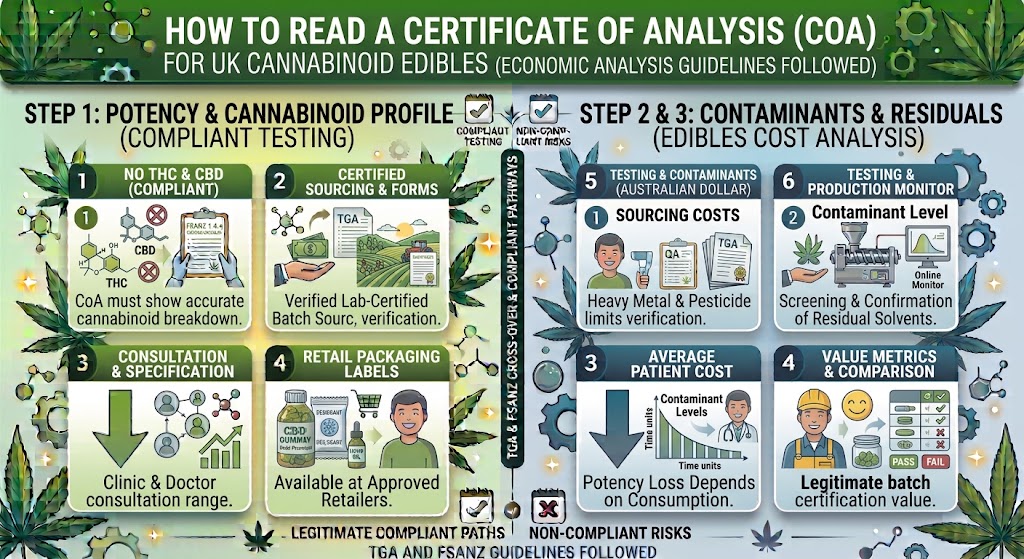
How to Read a Certificate of Analysis (CoA) for UK Cannabinoid Edibles
A Certificate of Analysis (CoA) helps consumers assess the quality of cannabinoid products, including THC gummies. Start by checking whether an independent laboratory conducts the testing. Look for its name, contact details, report number and accreditation, such as UKAS accreditation to ISO/IEC 17025 for the specific test. Confirm the report date and testing methods. A genuine-looking logo alone does not prove authenticity. Contact the laboratory using independently verified details if anything seems unclear. Most importantly, match the product name, batch number and sample description to the packaging. A report for another batch offers limited evidence about your product.
Next, examine potency and contaminant results. The CoA should list measured cannabinoids, including THC and CBD where relevant, with clear units and results per gram, serving or pack. Check that these figures match the label and distinguish “not detected” from “below the limit of quantification”. Review heavy metals such as lead, cadmium, mercury and arsenic, alongside pesticide screening and residual solvents. Check which substances the laboratory actually tests; a general “pass” does not cover every contaminant. UK Food Standards Agency research identifies variation in CBD content and potential contaminants across sampled products. A CoA supports assessment, but cannot guarantee complete safety
Finally, verify batch traceability before drawing conclusions about THC gummies in the UK. The batch or lot code on the pack should match the code on the CoA exactly. Check whether the report tests the finished edible rather than only a raw ingredient, and whether the sample description matches the product type. Be cautious of missing pages, altered reports, unexplained units or results without test dates. Testing does not establish that a product is legal to sell or possess. THC is controlled under UK law, while CBD food products face separate regulatory requirements. Consult official guidance and avoid products with unclear provenance or unsupported safety claims.
The Risks of Black-Market "Nerds Ropes" and Unregulated THC Edibles
Black-market THC gummies, including counterfeit sweets sold as Nerds Ropes, pose serious risks to consumer safety in the UK. Colourful packaging and familiar confectionery brands can disguise unknown ingredients and misleading THC claims. Some illicit cannabis products contain synthetic cannabinoids, commonly associated with substances such as Spice, rather than natural THC. These chemicals can produce unpredictable effects and severe reactions. The UK Government warns that illicit products marketed as THC can contain dangerous synthetic cannabinoids. However, evidence about contaminated vapes does not establish that every counterfeit edible contains Spice. Consumers should avoid unverified THC gummies, particularly products sold without reliable labelling or traceable ingredients.
Counterfeit THC gummies create additional risks because their appearance offers little evidence of their contents. Illicit packaging may copy established sweet brands, display false potency figures or omit ingredient information. Synthetic cannabinoids can cause agitation, confusion, vomiting, seizures, rapid heart rate and loss of consciousness. Effects vary according to the substance and amount consumed. Edibles also delay intoxication, increasing the risk of accidental overconsumption. Never assume that a sweet is safe because it resembles a familiar product or carries a laboratory certificate. Avoid products with broken seals, suspicious branding or unverifiable batch numbers. Keep suspected drug-infused sweets away from children and pets.
UK consumers should understand that THC gummies are not ordinary, freely marketable sweets simply because sellers advertise them online. Cannabis and controlled THC products are subject to UK drug laws, with limited lawful exceptions. The Home Office explains the relevant restrictions on possessing, supplying, producing and importing controlled cannabis products. If someone experiences severe symptoms after consuming a suspected counterfeit edible, call 999 or seek emergency medical help. Do not induce vomiting or give them more substances. Report suspected illegal products to the relevant authorities and seek advice from a medical professional if exposure occurs. Consumer awareness, reliable evidence and caution help reduce preventable harm.
Optimal Shelf Life and Storage: Keeping Gummies Potent and Fresh
Proper storage plays an important role in the shelf life and stability of THC gummies. Cannabinoids are sensitive to environmental conditions, especially ultraviolet (UV) light, heat and oxygen. Prolonged exposure can gradually reduce THC levels and alter a product’s chemical profile. Research shows that THC can oxidise into cannabinol (CBN) during ageing and unsuitable storage. The speed of degradation depends on several factors, including temperature and light exposure. Although gummies contain additional ingredients, their exact shelf life varies with the recipe, packaging and preservatives. Always follow the manufacturer’s storage instructions and check the stated expiry or best-before date.
Heat, moisture and oxidation can also affect the texture, flavour and overall quality of THC gummies. Warm conditions may soften gummies, while humidity can encourage unwanted changes or microbial growth in some formulations. Repeatedly opening packaging introduces air and moisture. Direct sunlight also increases exposure to light and heat. Keep products in their original, tightly sealed packaging and follow the label’s temperature guidance. Do not assume refrigeration or freezing is always suitable, as condensation and texture changes may affect some products. Never consume gummies that show mould, unusual odours, damaged packaging or unexplained changes in appearance. Visual checks cannot confirm cannabinoid potency or safety.
Child-resistant storage is essential wherever THC gummies or other cannabinoid products are legally held. Keep them in their original, clearly labelled containers, securely closed and locked away from children and pets. Do not transfer them into ordinary sweet jars or food containers, as this can cause accidental ingestion. Store them separately from everyday snacks and medicines. In the UK, cannabis and controlled THC products are subject to legal restrictions; only specific lawful circumstances and authorised medicinal uses may apply. Child-resistant packaging requirements also depend on the product’s legal classification. For further guidance, consult the Home Office and relevant product-safety regulations. Safety and lawful storage always come first.
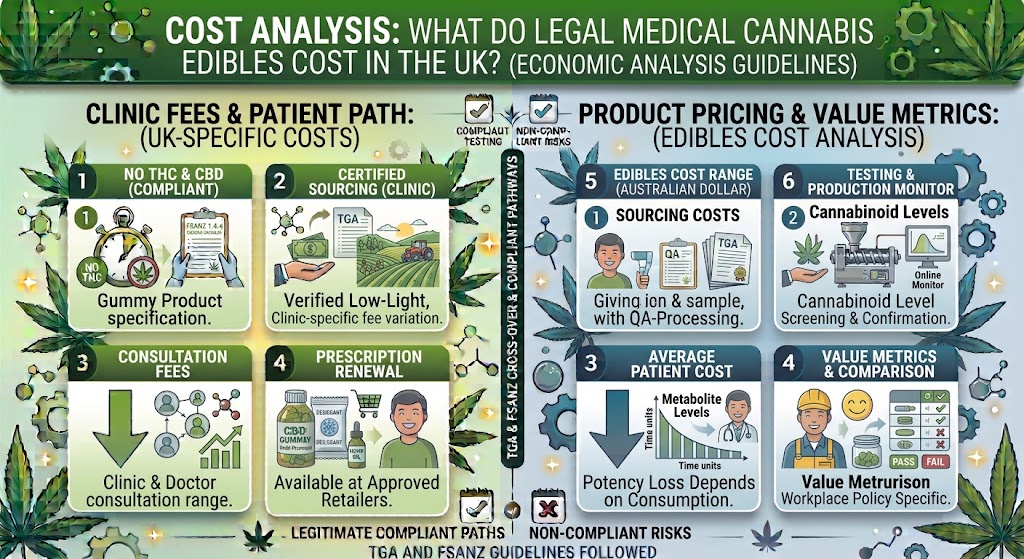
Cost Analysis: What Do Legal Medical Cannabis Edibles Cost in the UK?
The cost of THC gummies in the UK is partially determined by legal access, clinical assessment and prescribed medicine. Cannabis-based medicinal products are available only under specific legal conditions. A specialist doctor on the General Medical Council’s specialist register must prescribe most cannabis-based products for medicinal use. THC gummies are not a standard, universally available prescription format. Patients should contact clinics to find out which product formulations they can legally prescribe. Private treatment usually means consultation fees, further appointment fees, and the cost of the medicine. Prescriptions via the NHS (National Health Service) remain very limited. The NHS states that medical cannabis is suitable for only a very small percentage of patients according to current guidance.
Prices for private clinics vary across the UK. Curaleaf Clinic currently has appointments priced at £30 each, or a monthly subscription of £5 or an annual subscription of £50. The cost of the medication is additional. Can° Clinic has a one-time onboarding fee of £99 for new patients, which includes three follow-up appointments in a year priced at £29 each. Repeat prescription processing is free, however, other fees may apply. Releaf has a pay-as-you-go pricing structure, where a repeat prescription costs £19.99 and delivery costs an additional £4.99. The published prices allow patients to compare prices between clinics, but it doesn’t establish the cost of THC gummies.
To obtain the true cost of THC gummies, ask the clinic to provide a breakdown of the costs associated with an itemized estimate, including consultations and follow-up reviews, prescription processing, medication, dispensing and delivery. Divide the cost of the medicine by the number of units only if the prescription states the formulation and quantity is a gummy. Not all UK clinics offer THC gummies, and the price per gummy may vary. The NHS and Home Office offer information around eligibility, prescribing, and controlled drugs. Prices may vary, so check the most up to date prices before committing to treatment.
Frequently asked questions on THC Gummies in the UK
Are THC gummies legal in the UK?
The legality of THC gummies in the UK depends on their ingredients, intended use and legal authorisation. Recreational THC gummies are generally illegal to possess, supply, produce or import without the required lawful authority. Cannabis remains a Class B controlled drug under the Misuse of Drugs Act 1971. This means buying THC-infused sweets from an online shop, social media seller or unregulated retailer does not make the purchase lawful. Attractive packaging and claims of compliance offer no legal protection. The Home Office confirms that cannabis remains controlled, despite changes allowing certain medicinal cannabis products under strict conditions.
Medicinal THC gummies require a different legal assessment. UK law permits certain cannabis-based products for medicinal use under specific conditions. Most unlicensed cannabis-based medicines require a prescription or direction from a doctor on the General Medical Council’s Specialist Register. However, this does not mean every THC edible qualifies as an authorised medicine. A specialist prescription does not automatically legalise any product marketed as a gummy. Patients should confirm the exact formulation, supply route and prescription arrangements with their clinician and dispensing pharmacy. NHS guidance explains that medical cannabis is appropriate for only a limited number of patients and particular clinical circumstances
Before purchasing THC gummies in the UK, check the legal status of the specific product rather than relying on a seller’s claims. Products containing THC may fall under controlled-drug rules even when labelled as sweets, supplements or hemp products. CBD products are not automatically illegal, but applicable food, medicines and controlled-substance requirements still matter. Never assume that a low THC claim, a certificate of analysis or overseas availability proves lawful sale in Britain. For reliable guidance, consult the Home Office, NHS and current legislation. This article provides general legal education, not individual legal advice. Seek advice from a qualified solicitor if your circumstances require it.
How can I get a prescription for medical THC gummies in the UK?
If you are exploring THC gummies for medical use in the UK, start by understanding the legal prescribing process. Cannabis-based products for medicinal use (CBPMs) are legal under specific conditions. However, not every edible qualifies as a prescription medicine. Most unlicensed CBPMs require a prescription or direction from a doctor on the General Medical Council’s (GMC) Specialist Register. The NHS generally reserves medical cannabis for a small number of patients with specific clinical needs. THC pastilles and soft chews are not standard prescription formats across UK services. A specialist must assess whether a suitable product is clinically appropriate
To explore treatment, gather your medical history, current medication list, previous treatment records and relevant specialist letters. Discuss your symptoms and treatment goals with your existing healthcare team. NHS access is limited, while some patients explore private specialist clinics. Before booking privately, check the clinician’s GMC registration and confirm that they appear on the Specialist Register. The GMC provides an online register for these checks. During assessment, the specialist reviews your diagnosis, previous treatments, potential benefits, risks and possible drug interactions. A consultation does not guarantee a prescription. Clinicians must follow professional guidance and prescribe only when they consider treatment necessary and appropriate.
If a specialist recommends medical cannabis, ask which formulation is prescribed, whether it is licensed, how it is supplied and what monitoring you need. Do not assume that THC gummies, CBD pastilles or soft chews are available through a UK clinic. The prescribed product must meet the relevant legal requirements, and unlicensed medicines require particular clinical oversight. Avoid online sellers offering supposedly medical THC edibles without a valid prescription and lawful dispensing route. Unverified products may contain undisclosed ingredients or inaccurate cannabinoid levels. For reliable information, consult the NHS, GMC and NICE. This article is educational and does not replace medical or legal advice.
Can you buy real THC gummies on the UK high street or Amazon?
It is important to be cautious when buying THC gummies in the UK because not all products with cannabis branding contain the same ingredients. High-street shops and online marketplaces may sell products like CBD gummies or hemp products. Recreational high-THC edibles, like gummies, are illegal in the UK, and possessing or selling them is illegal under the Misuse of Drugs Act 1971, unless the individual has the appropriate authorization. Listings on Amazon do not mean the product is legal or correctly labeled. Products may not have undergone an independent lab test. It is important to check the ingredients, seller information and see if the product adheres to the appropriate laws in the UK before purchasing.
There are major differences between CBD and THC gummies. Only CBD food products that meet the required regulations are legal. Hemp seed oil is different from CBD. Products containing 1 mg or less of THC, subject to full legal requirements, may be exempt from the Misuse of Drugs Act 1971. This does not mean other legal requirements, or the product composition is correct. The product may still be unlawful. Always check the Food Standards Agency’s CBD product register and consult the most recent official home office position statement and guidance.
When shopping for THC gummies online or on the high street, make sure ingredient lists are clear and thorough, and accurately label the quantity of cannabinoids. Make sure batch details and independent laboratory tests are available. Otherwise, be wary of claims for THC-free gummies and ‘legal cannabis sweets’. The FSA warns that healthy adults should not take more than 10mg of CBD in a day and some products may contain controlled substances. It also reports inconsistencies and inaccuracies in labeling of sampled products and potential presence of contaminants. Do not give unverified high-THC sweets to children and keep all cannabinoid products out of the reach of children. Check the latest official guidance for the most up to date product rules and enforcement decisions.
Will eating THC gummies cause me to fail a workplace drug test in the UK?
Yes, eating THC gummies can cause a positive workplace drug test in the UK. These edible products contain tetrahydrocannabinol (THC), the psychoactive compound in cannabis. After consumption, the body processes THC into metabolites that drug tests can detect. The result depends on the dose, frequency of use, individual metabolism and test sensitivity. Workplace screenings commonly use urine or oral fluid samples. Each method has a different detection window. A positive result does not automatically prove current impairment. However, it may breach an employer’s drug and alcohol policy, particularly in safety-critical roles.
Saliva tests usually identify more recent THC exposure. Some workplace oral fluid tests detect THC for up to around 24 hours, although the window varies with the dose, test cut-off and individual factors. Urine tests detect THC metabolites for longer. After occasional use, detection may last several days; frequent or heavy use can extend it to two weeks or longer. These figures are estimates, not guarantees. Edibles may also produce delayed effects that last for several hours. No reliable calculation can predict exactly when a particular person will test negative after eating THC gummies.
UK employers should explain their drug-testing policies, obtain appropriate consent and ensure testing is justified, reliable and proportionate. The Information Commissioner’s Office advises that testing should serve a legitimate purpose, such as workplace safety, and that qualified professionals should interpret results. If THC gummies are medically prescribed, inform the relevant occupational health professional and follow the employer’s disclosure procedure; a prescription does not automatically prevent a positive result or guarantee exemption from workplace rules. Never drive or perform safety-critical duties while impaired. Disclaimer: This article provides general legal and educational information, not medical or employment-law advice.
Can I drive in the UK after taking prescribed THC gummies?
Driving after taking prescribed THC gummies requires careful attention to UK drug-driving laws. THC, or tetrahydrocannabinol, is the cannabis compound that can affect concentration, reaction times and judgement. Under Section 5A of the Road Traffic Act 1988, driving with THC above the specified blood limit can constitute an offence in England and Wales, even without obvious impairment. The specified limit for THC is 2 micrograms per litre of blood. However, prescribed medical cannabis patients may qualify for a statutory medical defence. This protection has strict conditions and does not make driving while impaired lawful.
The statutory medical defence is important for patients using legally prescribed THC gummies or other cannabis-based medicines. Under Section 5A, patients may have a defence if the medicine is prescribed or supplied for medical purposes, they follow their prescriber’s directions and relevant product instructions, and their possession is lawful. The defence does not apply if they disregard medical advice or instructions about how long to wait before driving. A prescription alone is not enough. Keep prescription details and packaging available to help explain lawful treatment if stopped. Seek advice from your specialist about driving before taking THC medicines.
Even with a valid prescription, you must never drive if THC gummies leave you impaired. Section 4 of the Road Traffic Act 1988 covers driving while unfit through drugs, and the statutory medical defence does not protect against this offence. Edibles can take time to produce effects, and their duration varies with dose, tolerance and individual metabolism. Do not rely on a fixed waiting period or assume you are safe because you feel normal. Follow your specialist’s specific advice and arrange alternative transport whenever effects may compromise driving. Disclaimer: This article provides general educational information, not individual legal or medical advice.
What is the difference between Delta-8, Delta-9, and CBD gummies in the UK?
Understanding the difference between THC gummies and CBD gummies helps UK consumers make informed choices. CBD, or cannabidiol, is a non-intoxicating cannabinoid. It does not produce the typical cannabis high. However, CBD gummies are not automatically legal simply because they contain no intended intoxicating ingredients. The Food Standards Agency (FSA) classifies CBD extracts and isolates used in foods as novel foods. These products require authorisation before they can legally be sold. As of October 2026, the FSA states that no CBD extracts or isolates have received novel food authorisation.
Delta-9-THC is the main intoxicating cannabinoid naturally found in cannabis. It can affect memory, coordination, judgement and reaction times. Delta-9 THC gummies may therefore carry significant legal and safety risks in the UK. Delta-8-THC is a closely related cannabinoid with psychoactive effects. Although small amounts may occur naturally, commercial Delta-8 is often produced by chemically converting CBD. This process can create unwanted by-products if manufacturers do not control and test production carefully. Neither a product’s online availability nor its hemp-derived label proves that it is safe or lawful in the UK.
CBD, Delta-8 and Delta-9 gummies have different effects, but every product requires careful scrutiny. In England and Wales, CBD food products must meet novel-food requirements, while products containing controlled cannabinoids may also fall under drugs legislation unless they satisfy the relevant legal exemption. Do not assume a “THC-free” label guarantees zero THC or a negative drug test. Check the FSA’s public list for CBD products linked to novel-food applications, and remember that inclusion is not full authorisation. Avoid unverified products making medical claims. Disclaimer: This article provides general educational information, not legal or medical advice.
How long do THC gummies take to kick in and how long do effects last?
THC gummies usually take around 30–90 minutes to produce noticeable effects, although some people wait two hours or longer. The timing depends on the dose, metabolism, stomach contents and product strength. Unlike inhaled cannabis, edible THC passes through the digestive system before entering the bloodstream. This delay can make the effects difficult to predict. Some people feel little at first and mistakenly assume the gummy is not working. Effects may then become much stronger. Understanding the onset time helps explain why THC gummies require caution. Unregulated products also carry extra risks because their ingredients and potency may be uncertain.
When you swallow THC gummies, the digestive system absorbs THC and transports it to the liver. This process is known as first-pass metabolism. Liver enzymes convert some THC into 11-hydroxy-THC, an active metabolite that can produce strong psychoactive effects. This helps explain why edible cannabis may feel different from smoking or vaping. Effects often peak around two to four hours after consumption. The experience varies between individuals and products. Dose, food intake, tolerance and metabolism all play a part. A delayed onset does not mean the product is ineffective, so avoid taking extra THC too soon.
The noticeable effects of THC gummies commonly last around six to eight hours, but they can continue for 12 hours or longer. Drowsiness and impaired concentration may persist after the strongest effects fade. Do not drive, cycle in traffic or operate machinery while impaired. Avoid mixing THC with alcohol or sedating medicines unless your clinician advises otherwise. In the UK, recreational THC products may also breach controlled-drug laws; prescribed cannabis-based medicines are subject to specific rules. Store gummies securely away from children and pets. Disclaimer: This article provides general educational information, not medical or legal advice. Speak to a healthcare professional about prescribed products.
Are THC gummies available on the NHS?
THC gummies are not routinely available on the NHS in the UK. The NHS prescribes certain cannabis-based medicinal products (CBMPs) only in specific clinical circumstances. These medicines require careful specialist assessment and are not the same as recreational THC gummies sold online. NHS prescriptions currently focus on a limited range of conditions, including certain severe forms of epilepsy, chemotherapy-related nausea and vomiting, and multiple sclerosis-related muscle stiffness. The available medicines usually take forms such as oils, capsules or mouth sprays. Patients should not assume that a prescribed cannabis medicine is available as a gummy.
NHS access to THC gummies for chronic pain, anxiety or sleep problems is highly restricted. NICE advises against routinely offering THC or CBD to manage chronic pain in adults outside specified circumstances, such as relevant clinical trials. THC gummies are also not an established routine NHS treatment for anxiety or insomnia. A specialist assesses the diagnosis, previous treatments, potential benefits and risks before considering a cannabis-based medicine. Most patients seeking THC treatment for these concerns do not qualify for NHS prescribing. A private consultation does not guarantee a prescription, and evidence for many unlicensed products remains limited
Some patients explore private medical cannabis clinics when NHS treatment is unavailable or unsuitable. A qualified specialist assesses medical history, current medication and previous treatment before deciding whether a cannabis-based medicinal product is appropriate. Private prescriptions involve consultation and medicine costs, and THC gummies are not guaranteed to be offered. Avoid unverified online products, which may contain undisclosed THC or other substances. Never replace prescribed treatment without medical advice. Disclaimer: This article provides general educational information, not individual medical or legal advice. Check current NHS and NICE guidance, and discuss persistent pain, anxiety or sleep difficulties with your GP
What happens if UK Customs or Border Force seizes imported THC gummies?
Ordering THC gummies from the USA, the Netherlands or Thailand does not make them legal to import into the UK. Products containing controlled cannabinoids, including THC, generally require the appropriate Home Office import licence unless a specific legal exemption applies. UK Border Force can intercept parcels containing suspected controlled drugs at ports, airports and postal hubs. The fact that THC gummies are sold openly overseas does not override UK law. Under the Misuse of Drugs Act 1971, unauthorised importation of controlled drugs is prohibited. Customs may seize a parcel even when it is intended for personal use
If Border Force seizes imported THC gummies, you may receive a seizure notice explaining what has happened and outlining your options. The notice may identify the goods, the legal basis for seizure and the relevant contact details. Seizure does not automatically mean that you face prosecution, but it should not be ignored. The outcome depends on the circumstances, the substance and the applicable law. GOV.UK explains that people can challenge a seizure or request the return of goods, subject to specific procedures and deadlines. Read the notice carefully and keep the packaging, order confirmation and all related correspondence.
If your THC gummies are seized, the parcel may be destroyed or forfeited. Importing controlled drugs without the required authority can also lead to criminal investigation or prosecution, depending on the evidence and circumstances. A seizure alone does not automatically mean you receive a criminal conviction. If you want to challenge the seizure, Border Force must generally receive your notice of claim within one calendar month. A request for restoration normally has a separate 45-day deadline. Check the official notice immediately, retain all documents and seek advice from a solicitor experienced in customs or drug law.
How much do medical THC gummies cost per month in private UK clinics?
Costs for medical THC gummies in UK private clinics are based on the prescribed product, dose and clinic fees. Importantly, clinics may offer cannabis pastilles, not gummies, and a specialist determines if any cannabis-based medicine is suitable. Curaleaf’s published prices list cannabis pastilles at £22.40 to £34.30 for a pack of 14, giving an indication price of approximately £48 to £74 for a pack of 30 pastilles, prior to clinic fees and other expenses. This example is for illustration purposes only, not a standard price or a guarantee that the product would be prescribed. Always check current pharmacy rates and availability prior to budgeting. Prices and products are subject to change.
Additionally, your first month may include the cost of a specialist consultation, which is charged separately from medication at some clinics. List prices for the first month vary from £29 at Alternaleaf to £150 for Mamedica’s standard onboarding option, and £30 at Curaleaf. Other clinics may charge for follow up reviews, while some offer memberships and bundled appointments to reduce costs.
Prices for repeat prescriptions vary from provider to provider. Some charge an administration fee. Delivery costs may be additional. To create a realistic monthly budget, charge clinic costs incurred one-off or periodically throughout the year. Add the estimated price of the medication, and repeat, dispensing and delivery costs. Ask before booking today.
As a reference, the cost of the medicine alone may be around £48-£74 monthly for a prescription of 30 pastilles at the quoted price. The cost may be higher, or lower, based on the strength and quantity of the prescription. The cost may differ if THC is not required, or a lower strength is required. The pastilles are not over-the-counter candy. UK medical cannabis products containing THC are prescribed by a specialist doctor and are not available over-the-counter. Treatment is at the doctor’s discretion, and not guaranteed. For the education of the patient, a clinic should provide an estimated cost breakdown for consultation, review frequency, repeat prescriptions, pastille price, dispensing and delivery. This article is for education purposes only. It is not medical or financial advice.
What are the dangers of black-market THC gummies like ?
Black-market THC gummies can look like ordinary sweets, but their contents may be unsafe or falsely labelled. In the UK, illegal street edibles may contain far more THC than the packet claims, uneven doses between sweets, or unexpected substances such as synthetic cannabinoids known as Spice. These chemicals are not the same as cannabis-derived THC and can produce stronger, less predictable effects. UK researchers and police have raised concerns after seized gummies tested positive for Spice and showed inconsistent THC levels. Attractive packaging, familiar sweet brands and impressive milligram claims do not prove a product is genuine, accurately dosed or safe.
Irregular dosing makes THC gummies especially risky because the effects of swallowed cannabis can take time to appear. Someone may eat another sweet too soon, then experience unexpectedly intense intoxication. Possible effects include confusion, vomiting, panic, paranoia, hallucinations, a racing heartbeat and poor coordination. Synthetic cannabinoids can also cause seizures, collapse or other life-threatening reactions, sometimes quite suddenly and severely. The strength and duration of a reaction are difficult to predict, particularly when the ingredients are unknown or mixed with alcohol or other drugs. Keep illicit edibles away from children and pets, and never assume a small-looking gummy contains a small dose.
Avoid eating black-market THC gummies, especially products sold through social media, street dealers or counterfeit sweet packaging. A logo, QR code or claimed laboratory result cannot independently verify what is inside. If someone becomes severely unwell, has a seizure, struggles to breathe, collapses or cannot be woken, call 999 immediately. Stay with them and tell medical staff what they may have taken; do not make them vomit or give them more substances. In the UK, THC-containing products are subject to controlled-drug laws, and access to cannabis-based medicines follows specialist prescribing rules. This article is educational, not medical advice here.
Can you fly on UK domestic flights with prescribed THC gummies?
Yes, you can generally fly on UK domestic flights with legally prescribed medical cannabis, provided you carry the medication prescribed to you and can verify your prescription. This includes domestic routes such as London to Edinburgh. However, prescribed THC gummies require particular care because not every cannabis edible is a legally prescribed medicinal product. UK medical cannabis rules allow certain cannabis-based medicines under specialist prescribing arrangements, but this does not automatically make commercially sold THC gummies legal. Before travelling, check that your specific product is lawfully prescribed and dispensed. The NHS medical cannabis guidance explains the importance of prescription evidence and matching identification. These precautions help patients travel with greater confidence.
Before your flight, ask your prescribing clinic for a travel letter confirming your treatment. Ideally, it includes your full name, the medicine’s name, THC strength, prescribed dosage, and the clinician’s contact details and signature. Carry your original pharmacy-labelled packaging, a copy of your prescription, the clinic letter and photographic identification. Keep your prescribed THC gummies in their original packaging and place them in your hand luggage for easy access. The UK Civil Aviation Authority advises passengers to carry supporting medical information when travelling with medication. Read its guidance on travelling with medicines. Contact your airline and departure airport before travelling to confirm any additional requirements for prescribed cannabis products.
At airport security, remain calm and provide your prescription documents if staff request verification. A clinic letter supports your explanation, but it does not legalise an otherwise unlawful product or replace the need for a valid prescription. Government guidance confirms that essential medicines can be carried in hand luggage, although controlled drugs are subject to additional rules. See the official GOV.UK hand luggage guidance. For domestic journeys, check the exact legal status of your medicine and follow your clinician’s dosing instructions. Do not share your THC gummies or take extra doses during the journey. This article provides general legal and educational information, not individual legal or medical advice. Confirm uncertain cases with your prescribing clinic and airline before departure.
What is the legal THC limit for CBD products in the UK?
Many are under the misunderstanding that THC-containing products are legal to sell in the UK as long as they contain less than 0.2% of THC by weight. This is a common but incorrect belief. Products must contain 0.2% or less of THC by weight to be legal if they come from a licensed hemp cultivation. However, a given product doesn’t need to be derived from licensed hemp cultivation to be legal. If it contains 1mg or less of a controlled substance, then, in theory, it can be legal to sell. This distinction is made clear by the UK Home Office in its guidance on CBD products.
A product that contains less than 1 mg of THC does not necessarily mean that the product is legal. The 1 mg THC limit refers to the total amount of THC in the container. Therefore, a product can be legal if it contains THC as long as it contains less than 1 mg in total throughout the product.
The FSA sets a threshold of 0.2 mg when deciding whether CBD foods comply with controlled drug requirements. In assessing CBD products, the FSA reports concerns over false labeling and unexpected levels of cannabinoids. It is worth noting that the 0.2 mg threshold doesn’t allow the sale of THC gummies. Other legal requirements still apply.
Customers wishing to buy THC Gummies or CBD products in the UK should check the Certificate of Analysis (CoA) from an independent laboratory. THC levels should be measured along with other controlled cannabinoids. Other requirements should also be met, such as batch details and total quantity per finished product. “Hemp derived” or “THC free” claims should not be trusted. The FSA has confirmed that CBD extracts and isolates used in food are novel foods and require authorization before they can be sold. The 0.2 mg threshold does not confirm food law compliance. This article is for educational purposes and is not legal advice.
How do I read a Certificate of Analysis (CoA) for UK gummies?
A Certificate of Analysis (CoA) helps you assess the quality and safety of CBD gummies and THC gummies. It records laboratory findings for a specific product or batch. Start by checking the laboratory’s name, report number, testing date and batch number. Match these details against the packaging. Choose reports from independent laboratories with relevant UKAS accreditation to ISO/IEC 17025. Check that the accreditation covers the actual tests performed, not simply the laboratory itself. A genuine CoA should identify its analytical methods and reporting limits. However, a certificate does not automatically prove that a product is safe, legal or accurately labelled.
Next, examine the cannabinoid profile. Look for CBD, delta-9-THC and other relevant cannabinoids. Compare the measured quantities with the label, and check whether results appear in milligrams per gummy, milligrams per gram or percentages. These units are not interchangeable. Review the heavy metals panel for lead, arsenic, cadmium and mercury. Check pesticide screening for named substances and residual solvent testing for extraction chemicals. A result marked “ND” means not detected above the method’s detection threshold. It does not always mean absolute zero. The Food Standards Agency’s CBD product analysis highlights the importance of checking cannabinoid accuracy and potential contaminants.
Before choosing THC gummies or CBD edibles, confirm that the CoA matches the exact batch you intend to buy. Check its QR code or report number against the laboratory’s official website, where possible. Read any notes about testing limitations, measurement uncertainty and results outside specification. A report may test cannabinoids but omit pesticides or residual solvents. Never assume that untested contaminants are absent. The FSA’s 2022–23 CBD product survey identifies gaps in testing accreditation for certain analyses, including pesticide testing in gummies. In the UK, a CoA also does not establish legal compliance. Check current food and controlled-drug requirements before purchasing.
